
Why Is My Garage Door Opener Light Blinking?
The opener's main light flashes after the door bounces back up. Or a small light on the motor unit, the wall button or one of the sensors near the floor keeps blinking. A blinking light is usually the opener trying to tell you something. This guide covers what those blinks most often mean, the safe checks a homeowner in San Antonio, TX can make, and when it's time to call.
San Antonio Garage Door Experts is a free quote service, not a garage door company. It doesn't repair doors or set prices. Independent local garage door companies reply to requests and quote their own prices, and some of them may pay to receive requests.
The most common reason: the safety sensors
Openers made since January 1, 1993 must reverse within 2 seconds of contact with an obstruction and have secondary entrapment protection such as photo eyes (16 CFR 1211). On many openers, when the photo eyes can't see each other, the door won't close from the remote and the opener's main light flashes to point you toward the sensors.
The photo eyes are the two small units mounted low on each side of the door opening. Each usually has an indicator light. On many models, a steady light on both units means they're working, and a blinking or dark light on one unit means it can't see the beam.
Which light is blinking?
Where the blink comes from narrows things down. Light colors and blink codes vary by brand and model, so treat this table as a starting point and check your owner's manual or the manufacturer's website.
| Where the light is | What it often means | First check |
|---|---|---|
| Opener's main light flashes after the door reverses | Safety sensors blocked or misaligned | Clear the path, clean and align the photo eyes |
| One photo eye blinking or dark | That unit can't see the other, or has a wiring problem | Align it; look for a cut or loose wire |
| Small LED on the motor unit blinks in a pattern | A diagnostic code | Count the blinks and look up the code in the manual |
| Wall-control light blinking | On some models, a lock or vacation mode, or a wiring issue | Check for a lock button; see the manual |
| Light blinks or beeps when running on battery | Battery backup in use, or a low battery | Check power and the backup battery |
| Light flashes and beeps before the door closes | On some openers, a warning before a timer or app closes the door | Normal for those features |
Safe checks you can make
These checks need no tools beyond a soft cloth. Do them with the door fully closed or fully open, and keep hands away from moving parts.
Note which light is blinking
Main light, motor-unit LED, wall control or a sensor. If it's a pattern, count the blinks.
Clear the sensor path
Move bins, bikes, boxes and leaves. Look for cobwebs or a spider on the lens.
Clean both lenses
Wipe each one gently with a soft, dry cloth.
Check alignment
Make sure both units face each other at the same height. Turn the one that's off by hand until its light goes steady.
Watch for sun glare
Low afternoon sun can shine into a photo eye and keep the door from closing. If the problem comes and goes with the time of day, that's a clue.
Test the door
Close it with the remote, then check that it reverses when something is in its path.
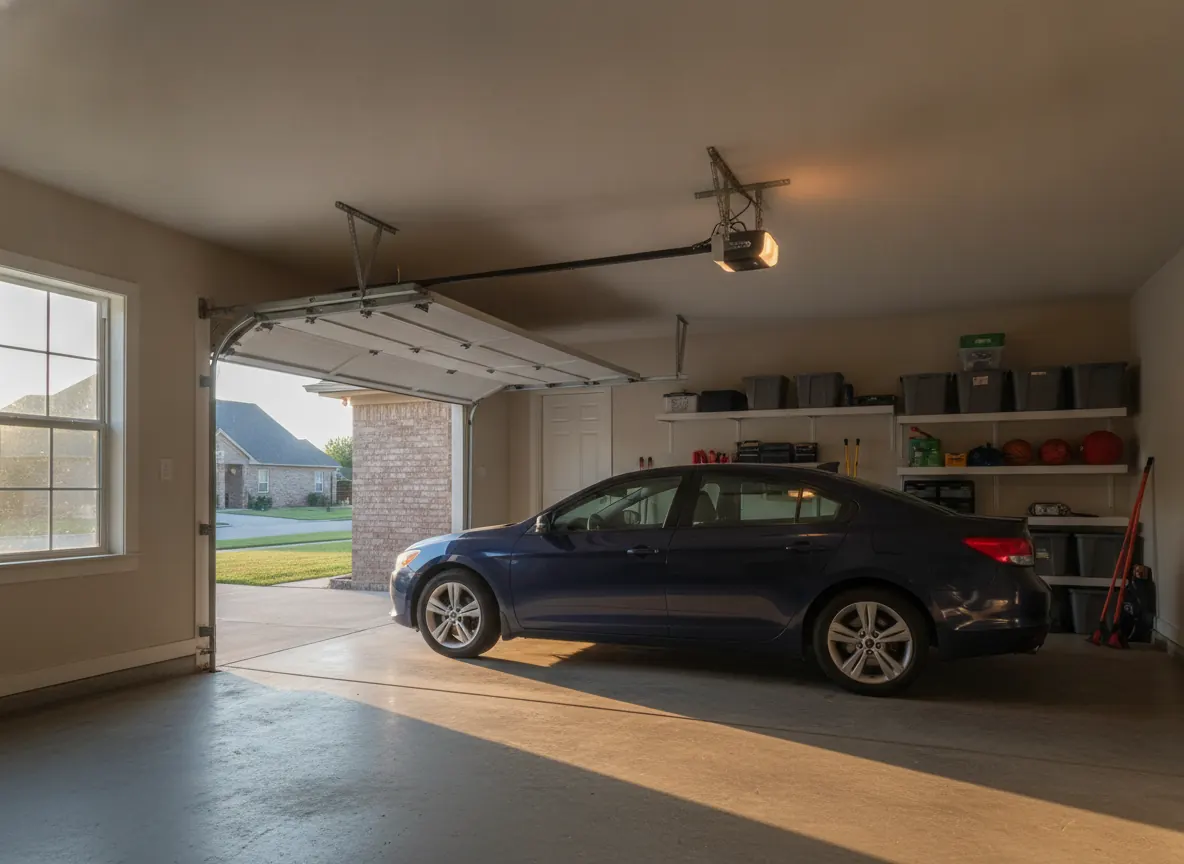
What not to do: Don't tape over, remove or bypass the sensors to stop the blinking. Don't open the opener's cover or splice wires. Don't touch springs or cables. Pull the emergency release only with the door fully closed. If the checks above don't fix it, that's a job for a technician.
Hot garages and opener lights
San Antonio averages about 122 days a year at 90°F or hotter and about 18 at 100°F (NOAA 1991–2020 normals), and 2023 set a record with 75 days at 100°F or more (National Weather Service). A closed garage on a summer afternoon can get much hotter than the air outside. Many openers have a thermal overload that can stop the motor when it overheats. If the opener quits after several runs on a hot day, let it cool and try again. If it happens often, mention it when you ask for quotes; it may point to a worn motor, a door that's out of balance, or a spring that's making the opener do too much of the lifting.
After a power outage
Some openers act oddly when power comes back after an outage, and some need remotes reprogrammed. During long outages, like February 2021, an opener without battery backup won't lift the door; know where your manual release is. Manufacturer guidance is to pull the release only with the door closed, check that the springs are intact first, and unplug the opener before working near it, since power can return suddenly. Don't force a door that's too heavy to lift. CPS Energy customers can check the CPS Energy outage map.
Battery backup is optional in Texas (California requires it; Texas does not). If you add an opener with backup, the backup unit may have its own warning beeps and lights.
When to call
- The light keeps blinking after cleaning and alignment.
- A sensor wire is cut, pinched or loose, or a bracket is bent.
- The motor-unit LED shows a code the manual says needs service.
- The door fails the monthly reversing test.
- The opener hums or clicks but the door doesn't move, which can point to a spring rather than the opener.
The sensor and keypad repair page covers photo eyes in more detail, and the opener repair page covers repair versus replacement. If the door won't close at all, see the door won't close guide.
Repair or replace the opener?
| Item | Typical range | Source |
|---|---|---|
| Opener repair | $100–$300 | Fixr, Jan 2025 |
| Opener, installed | $300–$600 (avg ≈ $480) | Fixr, Jan 2025 |
| Tune-up | $120–$240 | This Old House, Mar 2026 |
| Service call / trip fee | $50–$75 | Fixr, Jan 2025 |
On an older opener, ask whether repair or replacement makes more sense, and get both prices in writing. If a new opener needs a new outlet or circuit, that's electrical work for a licensed electrician. Texas doesn't license garage door companies (TDLR has no garage door program). The cost guide has the full price table and a calculator.
Texas consumer tip (educational, not legal advice): The Texas Deceptive Trade Practices Act lists as deceptive making false or misleading statements about the need for parts, replacement or repair service, and claiming work was done or parts were replaced when they weren't (Bus. & Com. Code §17.46(b)(13) and (22)). Ask for a written estimate, an itemized invoice and your old parts back. Complaints can go to the Texas Attorney General's Consumer Protection Division.
To get quotes from independent local companies, describe what the lights are doing through the free quote form or call (726) 600-2478.
Frequently asked questions
Why is my garage door opener light blinking?
On many openers, a blinking main light means the door reversed or won't close because the safety sensors can't see each other. Other blinks can be a diagnostic code, a wall-control lock, or a battery-backup alert. Codes vary by brand and model, so check the owner's manual.
How do I stop my garage door opener light from blinking?
Find the cause first. Clear anything between the photo eyes, wipe both lenses, and gently realign a sensor whose indicator light is blinking or dark. If the light keeps blinking, count the blinks and look up the code in the manual, or have a technician check it.
Can heat make a garage door opener stop working?
It can. Many openers have a thermal overload that can stop the motor when it overheats, which is more likely after many cycles in a hot garage. Let it cool and try again. If it keeps happening, have the opener checked.
Do I need a battery backup on my opener in Texas?
No. Battery backup is optional in Texas (California requires it; Texas does not). It can help during outages. Some battery-backup openers beep or blink when the battery is low or the unit is running on battery.